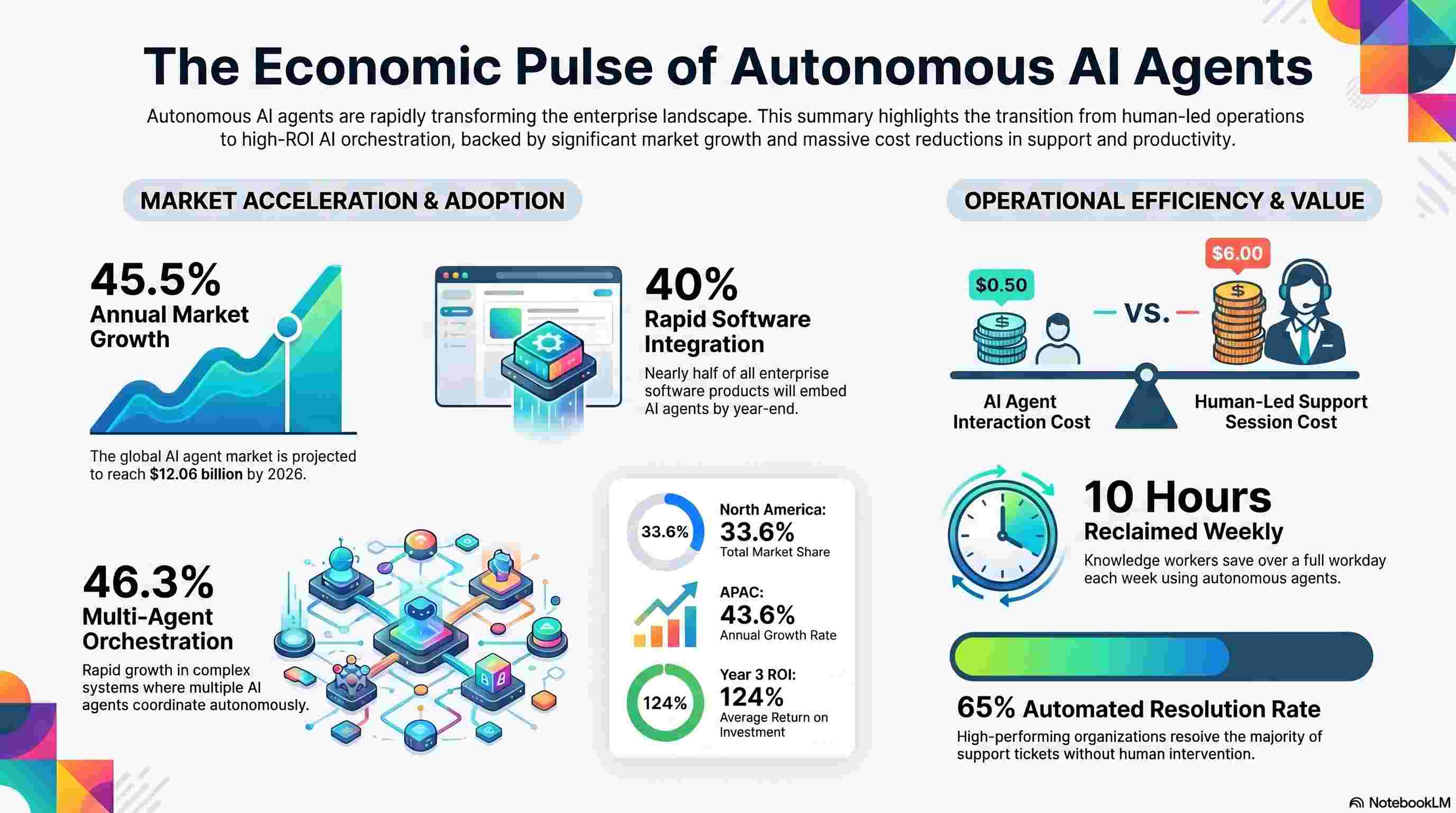
The global AI agent market hits $12.06 billion this year. Here's every number you need — and the business reality behind them.
- →Global AI agent market size: $12.06 billion (2026)
- →Annual growth rate: 45.5% CAGR
- →Cost per AI agent interaction: $0.50 vs. $6.00 for human support
- →Average ROI by year three: 124%
- →Knowledge worker time saved per week: 10 hours
- →Support tickets resolved without humans: 65% at high-performing orgs
- →North America market share: 33.6%
- →APAC growth rate (fastest globally): 43.6% annually
- →Enterprise software embedding agents by year-end: 40% of all products
- →Multi-agent orchestration growth rate: 46.3%
Autonomous AI agents — software systems that can plan, act, and complete multi-step tasks without human input — have moved from research labs to boardrooms faster than almost any enterprise technology in recent history.
In 2026, the global AI agent market is valued at $12.06 billion, growing at a 45.5% compound annual rate, and reshaping how businesses across BFSI, retail, IT, and operations run their workflows.
This article covers the latest AI agent market size statistics for 2026, what's driving growth across regions, the ROI data businesses are actually seeing, and what it signals for companies evaluating agentic AI today.
- —The global AI agent market will reach $12.06 billion by end of 2026
- —Industry growth is sustained at a 45.5% compound annual rate
- —North American enterprises hold 33.6% of global AI agent revenue
- —Asia-Pacific is the fastest-growing region at 43.6% annual growth
- —Single-agent systems hold 58.12% of the current market
- —Multi-agent orchestration demand growing at 46.3%
- —Enterprise vendors will embed agents in 40% of all software products by year-end
- —Autonomous agent platforms creating $31.46 billion in new addressable market value
- —65% of support tickets at high-performing organisations resolve without a human
- —Knowledge workers saving an average of 10 hours per workweek with agents
- —AI agent interaction cost: $0.50 per ticket vs. $6.00 for human labor
- —Financial sector fraud investigation cycles reduced by 30% using agents
- —BFSI sector holds 25% of total AI agent market share
- —70% of cloud incidents are now auto-remediated by agents
- —Three-year average ROI on agentic systems: 124%
- —Organisations without AI-ready data face a 15% productivity loss vs. peers by 2027
- —Early adopters report 1.7x higher ROI vs. businesses in evaluation mode
- —Customer expectation: instant resolution for 70% of standard queries
What Is an AI Agent? (And Why It's Different From a Chatbot)
Most businesses have already used AI in some form.
A prompt. An answer. Done.
That's not an AI agent.
An AI agent is a system that can observe a situation, decide on a course of action, take that action, check the result, and adjust — all without waiting for a human to press "go" at each step.
The difference in plain terms:
AI chatbot — "Here's how you could write that follow-up email."
AI agent — Writes it. Sends it. Logs the activity. Sets a reminder for next Thursday.
This is why the market is moving so fast.
Businesses aren't just buying smarter answers anymore. They're buying completed tasks.
AI Agent Market Size and Growth Rate in 2026
The global AI agent market is valued at $12.06 billion in 2026, sustained by a 45.5% compound annual growth rate.
For reference — the global SaaS market took nearly two decades to build comparable velocity.
This isn't speculative growth. This is adoption already in progress:
- —40% of enterprise software products will have agents embedded by year-end — tools businesses already pay for, becoming agentic without a separate purchase
- —The broader autonomous agent ecosystem is unlocking $31.46 billion in new addressable market value
- —Single-agent deployments still hold 58.12% of the market — most adoption is still early-stage, meaning the ceiling is wide open
The structure of the market itself is shifting.
Multi-agent orchestration — where multiple specialised agents coordinate on complex workflows — is growing at 46.3%.
Not one agent answering emails. A fleet of agents managing your entire customer lifecycle end to end.
Which Regions Are Driving AI Agent Adoption?
North America
North American enterprises hold 33.6% of global AI agent revenue, largely driven by hyperscaler investment — Microsoft Azure, Google Cloud, and AWS — which have made agentic deployment accessible at enterprise scale.
Asia-Pacific and India
APAC is the fastest-growing region in the world for AI agent adoption at 43.6% annually.
Why?
Not because they have better AI.
Because they don't have the legacy infrastructure holding them back.
India and China are building agentic systems on clean, modern tech stacks — no decade-old ERP integrations to untangle, no data silos from five acquisitions ago.
For businesses in India specifically, this is a rare moment of parity with global competitors. The tools available here are the same ones being deployed in Silicon Valley. The gap is purely in decision-making speed.
The Real ROI of AI Agents: Cost, Savings, and Productivity Numbers
This is where the math gets impossible to ignore.
- —Human support agent: $6.00 per interaction
- —AI agent for the same task: $0.50 — a 90% cost reduction per ticket
- —High-performing organisations resolve 65% of support tickets without any human involvement
- —Knowledge workers save 10 hours per workweek — not by doing less, but by offloading repetitive admin work
- —Average ROI on agentic systems hits 124% by year three
The 10-hour saving per week isn't about cutting headcount.
It's about your team finally doing the work they were actually hired for — instead of spending half their day on scheduling, data entry, and sorting tickets that an agent could handle in seconds.
AI Agents in BFSI, IT Operations, and Enterprise Workflows
Financial Services (BFSI)
The financial sector is one of the most advanced adopters of agentic AI — and for a specific reason.
High-compliance environments need reasoning logs. Step-by-step records of why a decision was made. AI agents provide exactly that by default.
Result: BFSI now holds 25% of the total AI agent market share, and financial institutions have cut fraud investigation cycles by 30% using agents to monitor, flag, and escalate anomalies in real time.
IT Operations and Cloud Infrastructure
70% of cloud incidents are now auto-remediated by agents.
The IT manager's role isn't disappearing. It's becoming more strategic.
Not "the person who fixes the server at 2am." But the person who sets the rules the agent uses to fix the server at 2am — and reviews what it learned.
Enterprise Software
By end of 2026, 40% of all enterprise software products will have agents embedded directly. The switching cost for adoption is dropping to near zero.
Why 40% of AI Agent Projects Still Fail
Here's the part nobody puts in the press release.
A significant number of agent deployments underdeliver. And the reasons are almost never about the AI.
Reason 1: Data That Isn't Ready
An agent is only as useful as the data it can access.
If your customer history lives in three separate tools with no clean API, your agent makes decisions on incomplete information. That's not an AI failure — that's an infrastructure failure.
Organisations without clean, accessible data foundations are projected to see a 15% productivity loss compared to AI-ready peers by 2027.
Reason 2: No Governance Framework
As agents move from single tasks to multi-step workflows, the question of "what is this agent allowed to do?" becomes critical.
Can it send emails autonomously? Can it initiate a refund? Can it commit a purchase order?
Without defined agent permissions and guardrails, autonomous systems don't just fail silently — they can make unauthorised commitments before anyone notices.
Governance isn't a blocker to deployment. It's what makes deployment at scale actually safe.
What the $12 Billion Market Shift Signals for Businesses in 2026
The milestone isn't just a market data point.
It's a signal that the "let's experiment with AI" phase is over.
- —Customer expectations have already moved. A 24-hour response time is now a service failure. Customers expect instant resolution for 70% of standard queries
- —The hiring profile is changing. The role in demand isn't "someone to do manual tasks." It's "someone to manage the agents doing manual tasks"
- —Early movers compound their advantage. Early adopters already report 1.7x higher ROI vs. businesses still in evaluation mode — and that gap grows every quarter
Is the AI Agent Market Overhyped — or Just Misunderstood?
Fair question.
Every major technology wave produces hype that outruns reality for a period.
But the AI agent market data in 2026 isn't projection-based optimism. These are numbers from organisations that have already deployed, measured, and reported.
- —65% ticket resolution without humans — a live operational metric, not a forecast
- —$0.50 per interaction cost — a billing reality for teams already running agent-based support
- —124% three-year ROI — from companies who built their agents two to three years ago and can now measure the return
The hype risk in 2026 isn't that agents don't work.
It's that businesses deploy them without data readiness or governance — and then blame the technology when the real failure was the foundation.
Key Takeaways: AI Agent Market Statistics 2026
The global AI agent market in 2026 is a $12.06 billion industry growing at 45.5% annually.
The businesses pulling ahead aren't using a fundamentally different AI — they're deploying it with better data infrastructure, clearer governance, and a willingness to move before the conditions feel perfect.
The economic case is settled. The productivity data is real.
What's left is execution.
The shift from "AI as a tool" to "AI as a teammate" isn't coming.
It's already here. The only variable is how fast you move.
Research Sources & Citations ▼
- Research and Markets: AI Agents Global Report 2026
- Fortune Business Insights: Agentic AI Market Forecast 2026-2034
- Gartner: 2026 Strategic AI Spending Outlook
- Technavio: AI Agent Platform Growth Analysis 2026+
- Salesmate: 2026 AI Agent Adoption by Industry
Article Context & Metadata:
- Category: Statistics
- Topics: AI Market Growth, Global Tech Trends, 2026 Data, Enterprise Automation, Agentic AI ROI
- Last Updated: April 21, 2026

Anand Singh
Lead AI Automation Engineer
An AI Systems Architect specializing in Deep RAG and Agentic Swarms. Crafting custom logic blueprints and autonomous executors to bridge the gap between complex data and actionable intelligence.
READ_FULL_BIO ->